From Newark to the Network
Four YouthBuild graduates are learning to wire Newark’s digital future, one fiber splice at a time.
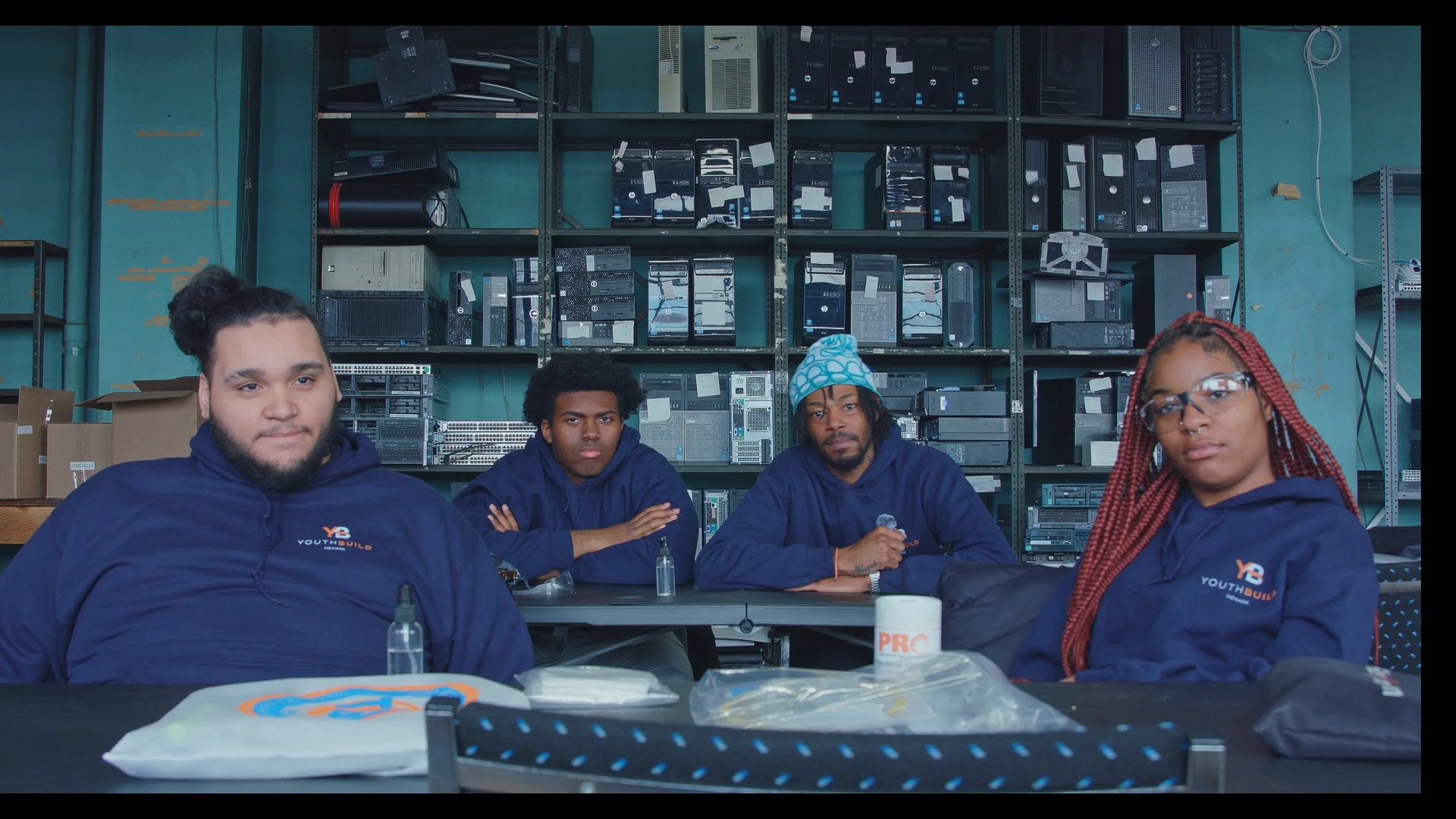
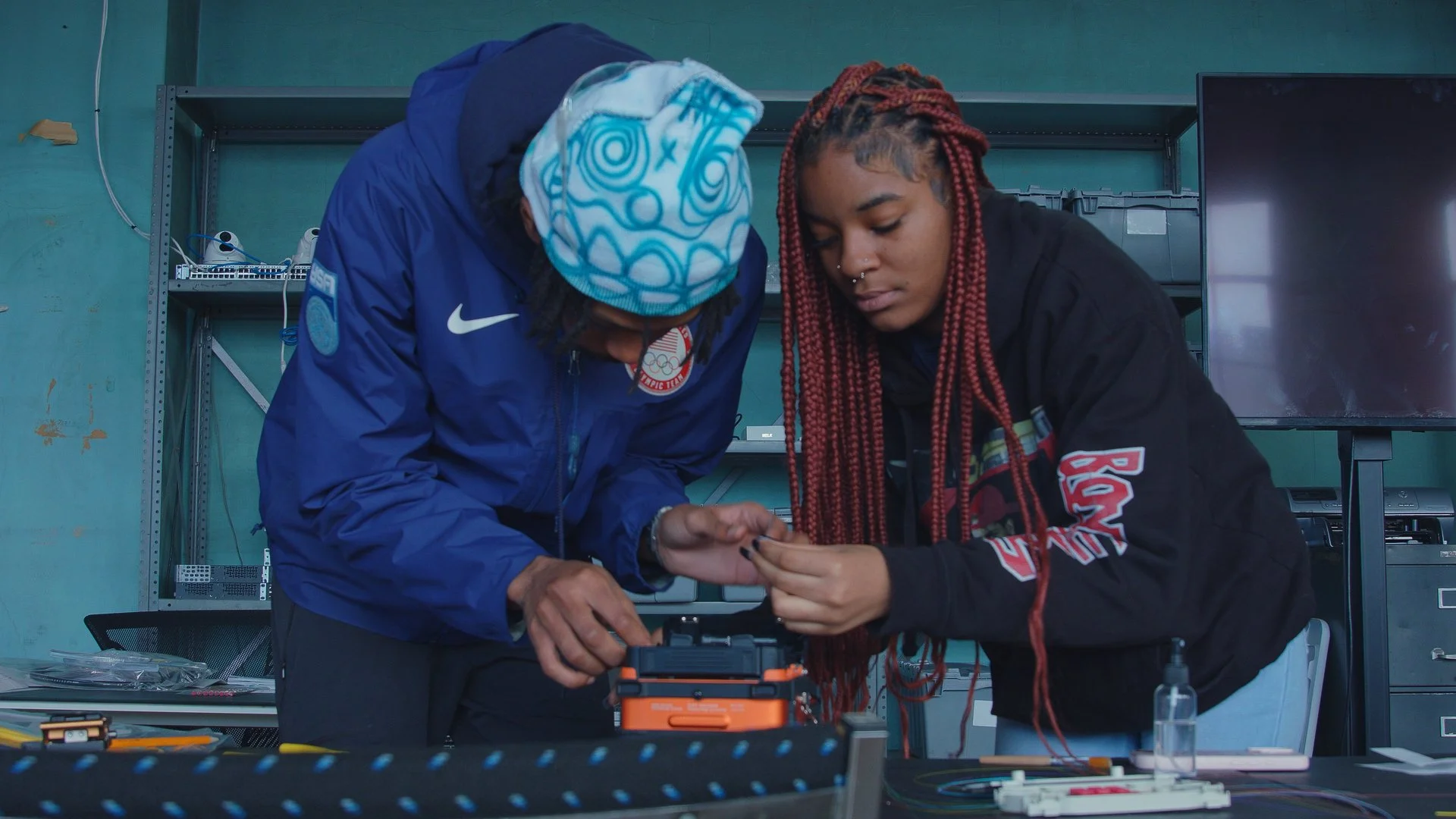
Clockwise from left: Matthew, Taj, Zacore, and Xiomara in their fiber optics workspace at RampUp America’s Newark location
Matthew almost stopped going. At a certain point during his time at LEAD Charter School, the educational partner of YouthBuild Newark, he had convinced himself there was no reason to be there. “If I’m not getting money, I shouldn’t be here,” he remembers thinking. He left to find work. Then his teachers called him back.
“Just try it out,” they told him. So he did.
That pattern of drifting, being called back, and taking the second chance offered, showing that the process of transformation isn’t always linear, runs through the stories of all four young people gathered together in a fiber optics lab in the heart of Newark. Matthew Ramirez, Xiomara Adams-Townes, Zacore Parrot-Hall, and Tajae (Taj) Gilford-Rogers are LEAD graduates and YouthBuild Newark alumni, enrolled in a hands-on technical training program with RampUp America, learning to splice fiber optics cable and talking about their roads to here.
CHALLENGING ROADS BECOME A PATH TO POSSIBILITY
LEAD and YouthBuild Newark are both initiatives of Opportunity Youth Network (OYN), a Newark-based nonprofit dedicated to reconnecting opportunity youth to education, employment, and career pathways. Taj came to LEAD because he was done with his previous school. “I never really liked the school and I just felt like I didn't need to be there anymore,” he says. When he heard that LEAD offered career and technical education programs, that was enough to make the move.
Zacore is the eldest of the group, a 2019 graduate who arrived at LEAD through a harder road until a probation officer eventually recommended the school. When he learned about the construction program, something clicked. “After finding out about the CTE, I was all set,” he says.
Xiomara came without a strong memory of who she was before LEAD, but she sees a new version of herself now. “I can say that LEAD has changed me for the better. I could do public speaking now. I communicate better. I’m more outgoing. I don’t know who I was outside of LEAD before,” she says.
Matthew’s path included failing grades, conflict, and a stretch of time when showing up felt pointless. His circumstances did not change, but the people around him did. “There are good teachers here,” he says. “This school just helps you be more of what you're afraid to be. It helps you be more open.”
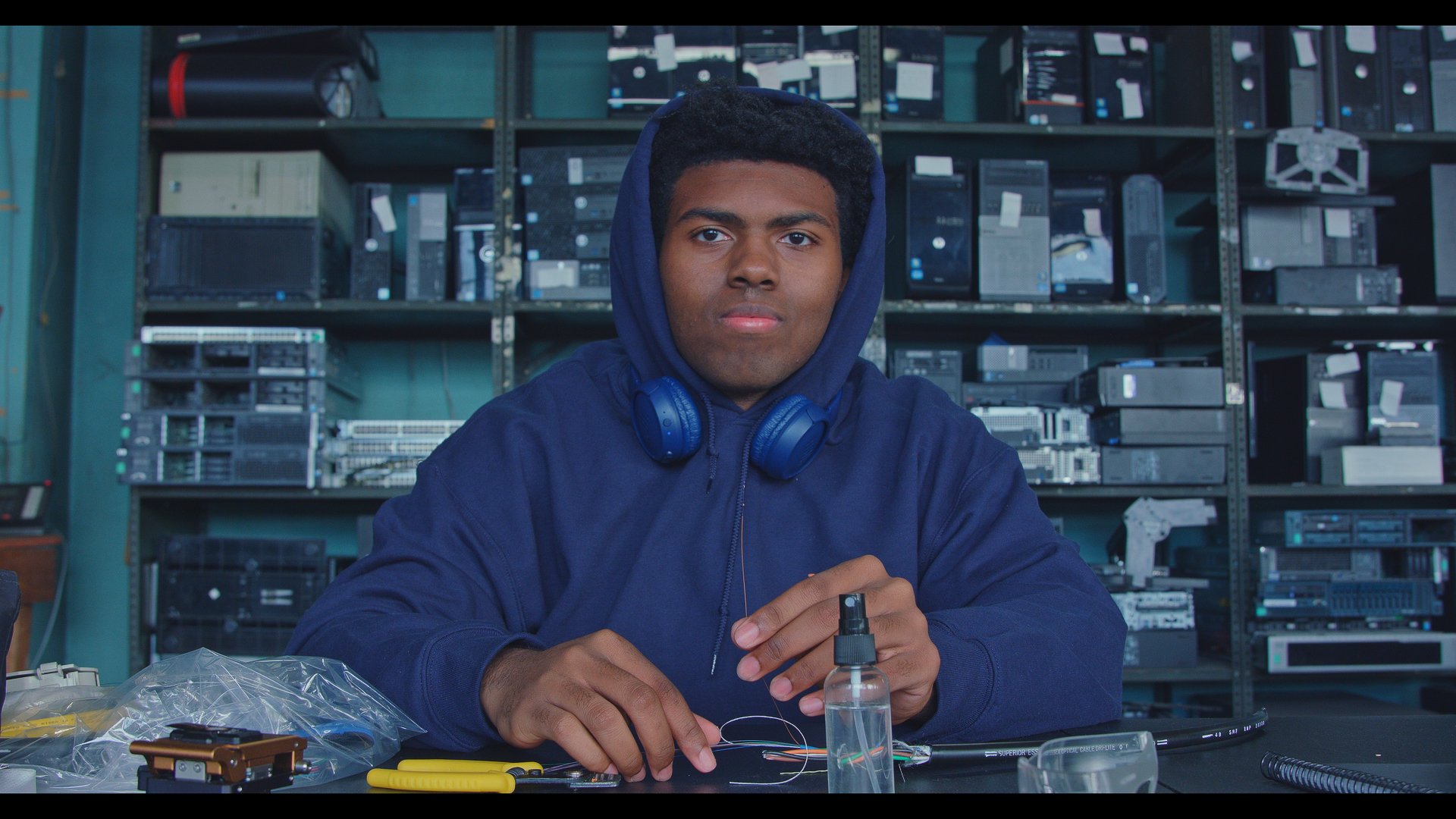
“When you engage these students properly, they are hungrier than a student who had a comfortable life and assumed the easy road would continue. They know what rude awakenings are. They are resourceful. They are willing to try something new.”
— James Walker
THE BRIDGE TO RAMPUP
For most of these students, the path to RampUp America ran through one person: Terry Lang, a construction instructor and YouthBuild alum himself known for picking up the phone. “Every time there’s a new certification available, he always calls us,” says Matthew. When Lang reached out about the fiber optics program, Matthew picked up. So did Taj, Xiomara, and Zacore, who had moved into property management work after graduating in 2019.
On the other end of that referral was James Walker, CEO of RampUp America. Walker is an entrepreneur who runs the program out of a five-story building in downtown Newark. A board member introduced him to OYN and the partnership made sense the moment he met the students.
The students arrived with OSHA certification and solar panel installation credentials already in hand from their time at YouthBuild. They knew how to handle tools and understood job site culture. Walker did not have to start from scratch. “These students are ready to learn the skill at hand, and to do so with excellence,” he added.
“OYN has a model, working especially well in Newark, that’s probably the best I have seen in terms of preparing students to be easy to teach in a workforce program. It's a model that should be learned from, and hopefully used in other parts of the country.”
— James Walker, CEO, RampUp America
LEARNING THE WORK
Fiber optics splicing is precision work. A single fiber, thinner than a human hair, must be stripped, cleaned, cleaved, aligned, and fused to another. A machine measures the light passing through the connection. Bright light means a good signal. Dim light means the splice failed and you start again.
When the group started in January, none of them had done this before. But several had been building toward it without knowing it.
Matthew, who spent time on construction sites cutting pipe and tubing through YouthBuild, found the transition intuitive. “The whole cutting the wire part was easy, because I got that training from prior experience,” he says. “Without this school, I would have never had that training.” He quickly figured out faster techniques and then immediately shared them with everyone else. “He’s the first to figure out a better, faster way than even what the textbook says,” Walker says. “I check the work and it’s the same quality. He’s teaching me another way.”
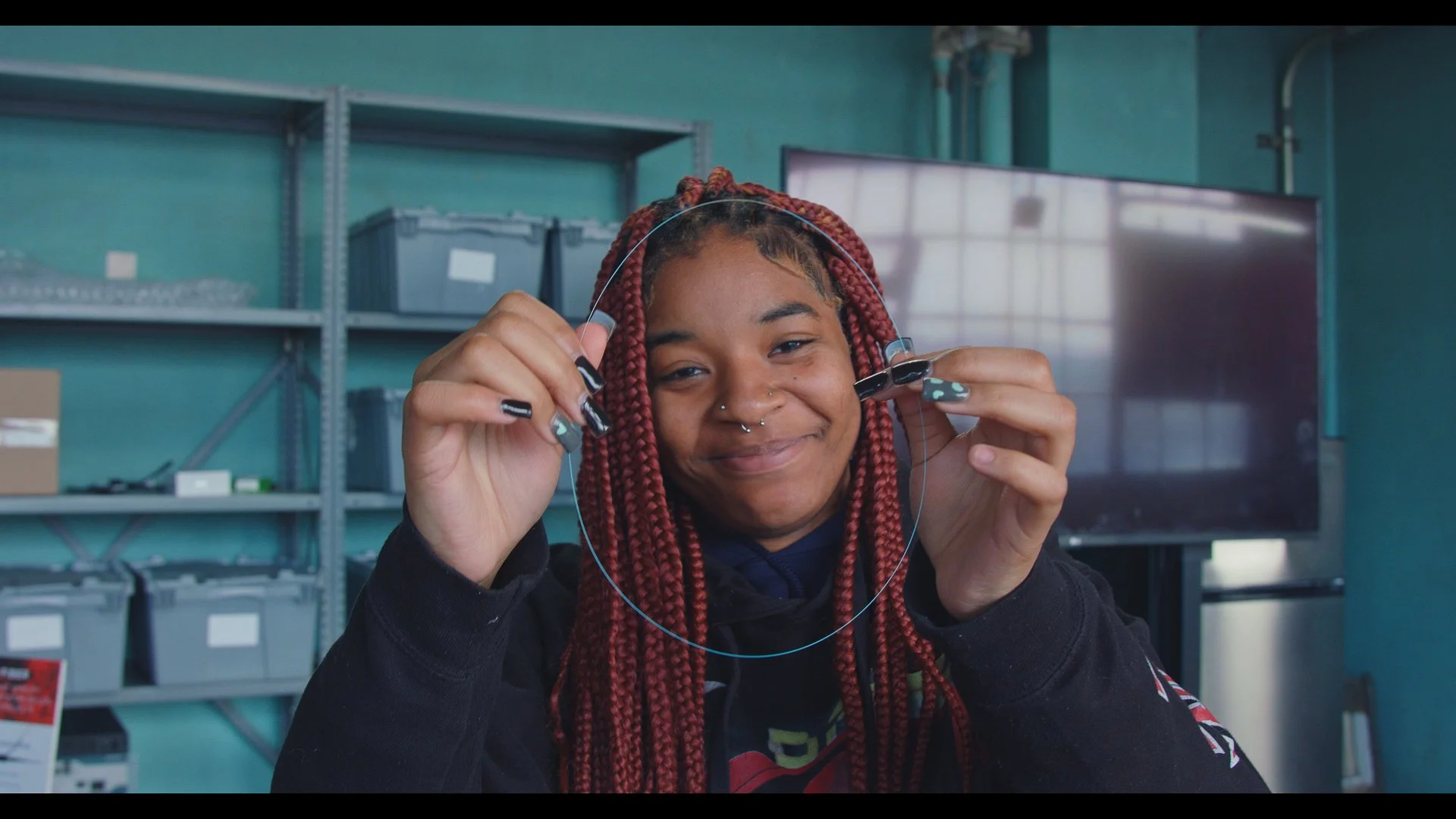
Xiomara found her edge in the precision work. Walker had observed early on that working with heavy-jacketed outdoor cable favored upper body strength, while the most technically demanding parts required a different kind of dexterity. “I asked her if she braids hair,” Walker recalls. “She does. And sure enough, how thin is a fiber? Thin as a hair.” When it came to alignment and accuracy, Xiomara’s results came in first. “Now, when it comes to accuracy and passing tests of perfection, her stuff is the best,” Walker says. “She let them have it.”
Zacore finds himself watching the younger students and seeing something familiar. “I see little remnants of people who trained me,” he says. “These guys were trained by guys I’ve been trained by.”
The group dynamic is one of the program’s strengths. They joke, then lock in, coaching each other without being asked. When someone figures something out, they share it. “Everybody here is ready to get their work done,” Taj says. “Work hard, hands on, push through whatever it is.”
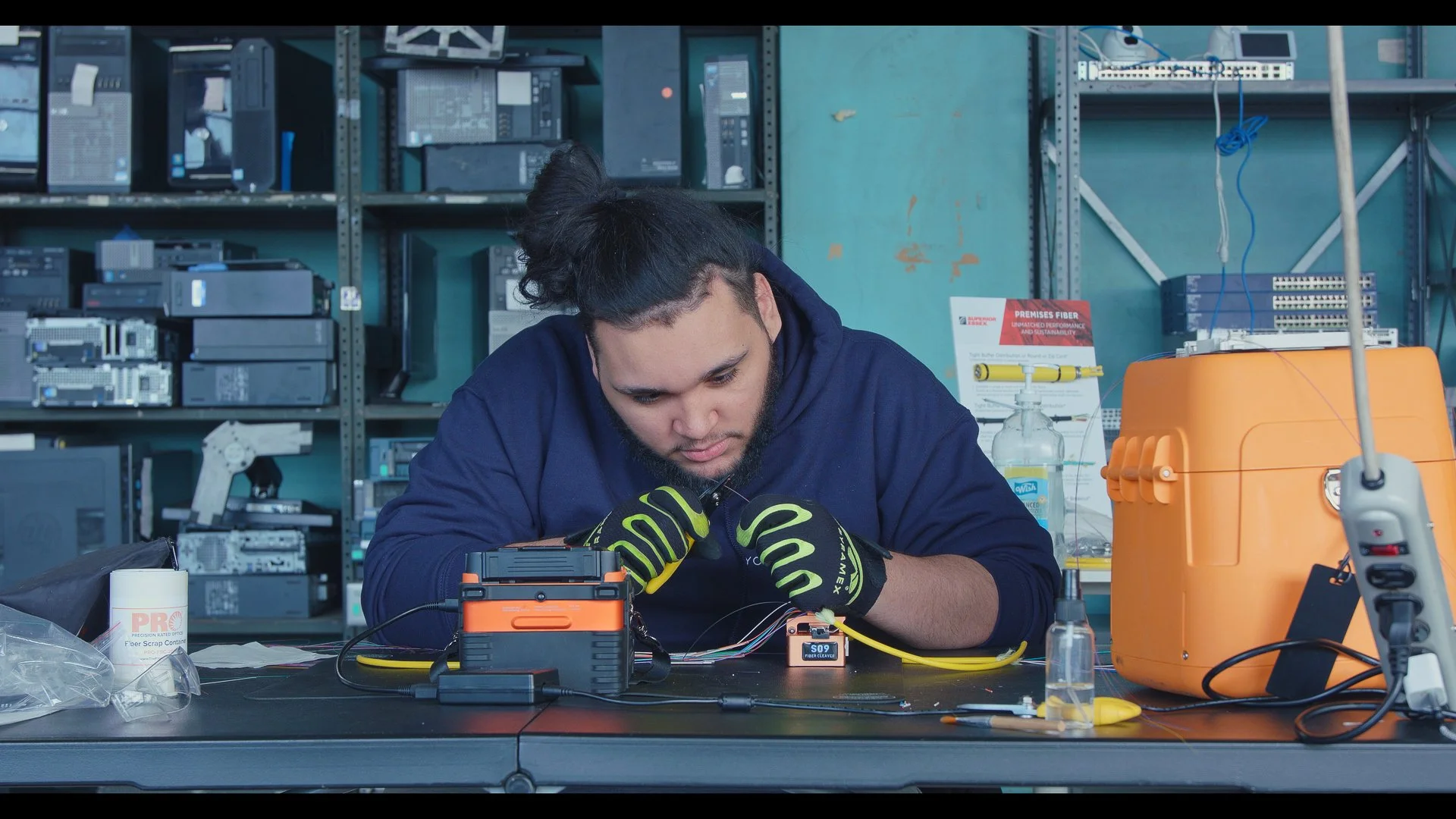
“It’s like a rhythm. I kind of understand it now. The way it launches together, the way you put the cap over. I find it fascinating.” — Matthew
WHO THEY ARE NOW
Something changes in a student when they realize they can do something they did not think they could. Matthew talks about it in terms of options. “Before LEAD, there weren’t a lot of options for certifications,” he says. Now he holds OSHA, solar, SCCR, and is adding fiber optics to the list. “I can never be jobless,” he says. “I have too much to fall back on.”
Xiomara, the only woman in the cohort, has developed a particular resolve. “Since I started these programs, I feel like it has given me a lot of strength and confidence,” she says. On the days that feel hard, she talks herself through it. “You came this far already. You’re the only girl. You might just see it through. You got this, just see it through.”
“Here you get to build your own legend. You get to step back and understand who you were compared to who you are now. And I feel like that’s the biggest growth opportunity in itself.” — Zacore
When asked to name one word that captured the transformation, their answers were their own. Matthew: evolve. Taj: determination. Xiomara: strength and motivation. Zacore says he uses L.O.V.E., which he described as an acronym for Living Off Value Energy. “Every day we wake up, we got a choice,” he said. “You have to live not in the ideas or the beliefs of what people want for you, but the energy that you value. Always love yourself, because you are the star in this show. Every day you wake up is your movie.”
WHAT COMES NEXT
In the final weeks of programming, the group will begin shadowing professionals in the building, meet with Essex County College about pathways into higher education, and interview with potential employers, including trade unions.
The fiber optics industry is a good place to be heading. National broadband expansion is driving sustained demand for trained technicians, and the work, as Walker often points out, is not going anywhere. No algorithm is going to climb into a ceiling and splice hair-thin glass so cleanly that laser light can travel through it at the speed of light. This is skilled labor, and it requires skilled people.
Walker has seen ambition like this across twelve years of working with students. However, what he sees in this cohort, and in what YouthBuild has fostered in them, is something he wants more employers to understand.
Their patience, technical fluency, determination, and willingness to be pushed and coached is what RampUp America is building on now.
Their paths depend, in part, on whether more employers, programs, and institutions are willing to see what Walker sees: not who these students were, but who they are now, and what they can do with their hands, minds, and time.
The connection has been made. What travels through it next is up to them.